Northern Explorer
Winter in Lofoten
Winter in Lofoten usually lasts from November to March, although snow and weather conditions vary from year to year. This guide explains what to expect from the daylight, weather, roads, northern lights, fisheries and winter activities—and how to plan safely.
Winter in Lofoten is exciting. The northern lights flare across the sky, you can enjoy “the blue hours” and fishermen are taking part in one of the world’s biggest cod-fishing events.
Winter is the season the islands were built around. Long before tourism, before the roads, the villages existed because the cod came in January. And they still do. Coming here in the cold months means seeing Lofoten doing what it has always done, in light you will not find at any other time of year.
Before we delve any deeper, let’s start with some practical questions commonly asked by visitors when planning their trip.
Winter runs roughly from November to March, with reliable snow most likely between January and March. However, this varies from year to year.
Each part of the season looks different. December brings with it the arctic night and a deep blue light, often referred to as the “blue hour”.
The daylight increases fast day by day and the skiers are back in the mountains, and the fishermen are out hunting for Skrei.
By March, the days are growing longer, with more than ten hours of daylight. The seasonal cod fishery continues until April, and March also brings the annual World Championship in Cod Fishing.
There is no single best time to visit during winter. It depends on whether you have come for the light, the snow, the fishing, or the quiet. Or all of it combined.
Milder than most people expect this far north. The Gulf Stream flows past the islands and keeps the coast far warmer than inland Norway or other places at the same latitude. Daytime temperatures usually sit between about −5°C and 5°C, dipping to around −5°C to −10°C during clear, cold spells. The trade-off is weather that changes fast. When mild Atlantic air meets cold Arctic air, you get wind, and you can see sun, snow, sleet and rain in a single day.
It depends on the month. Around the winter solstice you get only two to four hours where the sky brightens, and even then the sun stays below the horizon. After 21 December the days lengthen quickly. By mid-January the light is returning fast, and by March you have more than ten hours of daylight. What you lose in hours you gain in quality. The low sun keeps the sky in a long, slow sunrise-sunset for much of the day.
In Lofoten we call it the arctic night or “mørketiden”. It lasts from around 7 December to 5 January, when the sun does not rise above the horizon. It is not pitch black, as many believe. Because of our location, and how the earth is tilted, we get unique light here even though the sun doesn’t rise. For a few hours around midday the sky glows in deep blue, sometimes rose and gold, called the “blue hour” that photographers come here for. Snow on the ground, and the surrounding ocean reflects what little light there is, and the northern lights fill the rest.
Fun fact: When sun breaches the horizon again, locals celebrate in different ways and welcome the light back again.
Yes. Lofoten sits at about 68°N, directly under the auroral oval, a ring-shaped region centered around Earth’s magnetic poles where auroras (Northern and Southern Lights) most frequently occur. Which means the lights are often visible even when solar activity is modest.
The aurora season runs from roughly late August to early April. You need darkness, so it is a winter phenomenon. Two things have to line up: Activity in the sky and clear weather. Nothing is guaranteed on any given night, so give yourself several nights, get away from village lights, and keep an eye on the forecast. There is very little light pollution in Lofoten, so chances are really high, even directly in a village.
Pro tip: Book a northern lights tour with a local company. They know how to chase and find the northern lights.
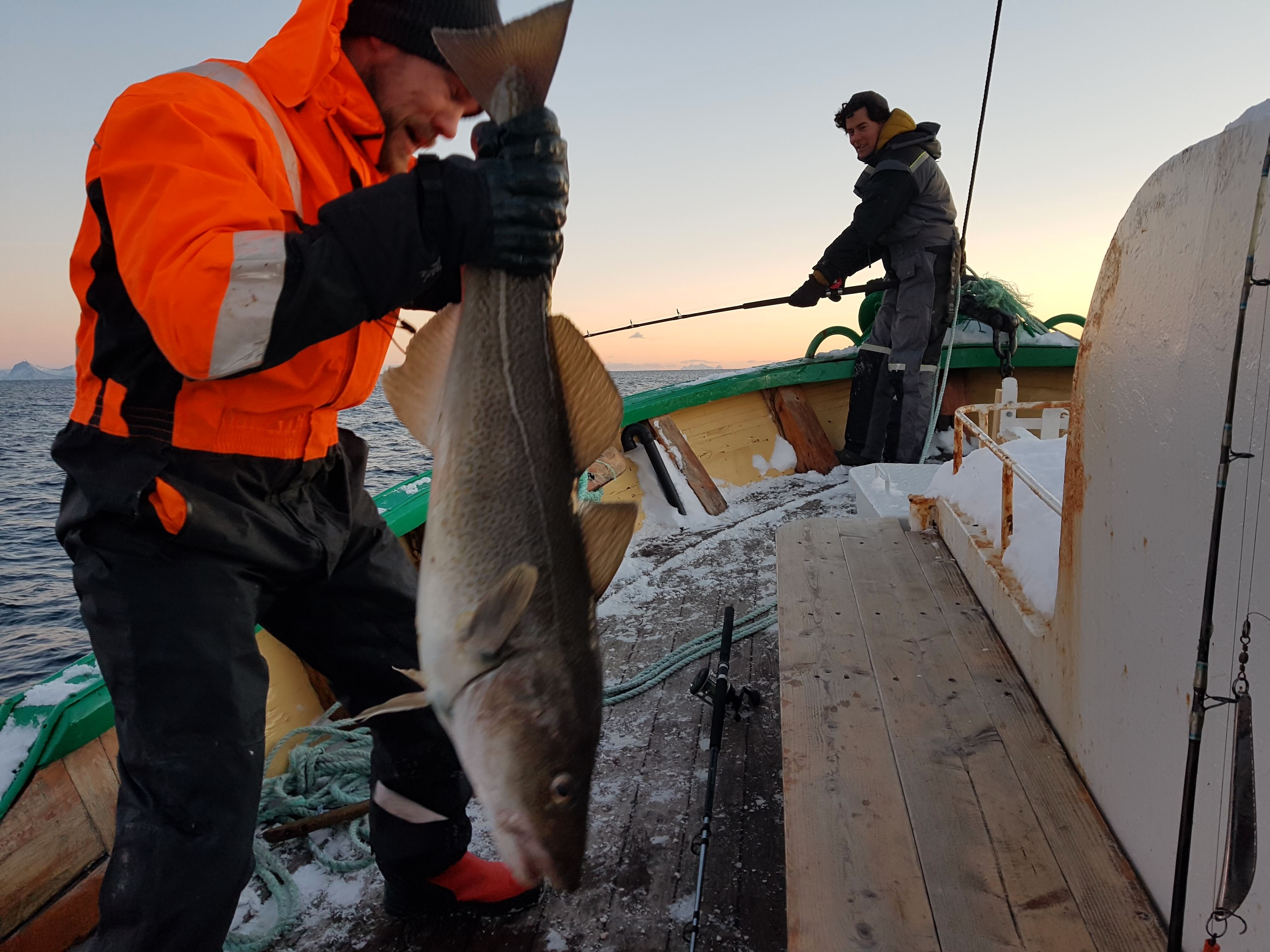
The Lofoten cod fishery is the reason the villages are here. From January to April the skrei (Arctic cod) migrate from the Barents Sea to spawn in the Vestfjord, and boats fish for them just as they have since before the Viking Age. Along the shore you will see the cod hung to dry on wooden racks, the hjell, producing the stockfish that has been traded from here for a thousand years. It is a working season, not a display.
To get the full background history of this rich heritage, make sure to visit SKREI, at Storvågen in Kabelvåg (The Otholith, Lofoten Museum, Gallery Espolin and the Lofoten Aquarium).
“VM i Skreifiske” has been held in Svolvær every year since 1991, usually in the third week of March. Around 600 anglers and a fleet of small boats take part, and the town fills with people. If you want to fish it yourself, book well ahead.
By air, the usual route is via Europe to Harstad/Narvik Evenes Airport (EVE) or Bodø Airport (BOO). We recommend checking out Discover Airlines (Lufthansa) or Fly Edelweiss.
You can also fly via Oslo to EVE or to Bodø. From Bodø, you can fly with Widerøe to Svolvær (SVJ), about ten minutes from the town centre, or to Leknes (LKN) in the west.
By road, Lofoten is connected to the mainland by the E10 via the Lofast link in the east, open since 2007, and the Bodø-Moskenes ferry in the west.
Many travel by rental car. However, we suggest checking for bus connections, especially the Airport Express bus from Evenes to Svolvær. It’s tough even for locals to drive on narrow winter-roads after a long, warm and comfy flight.
In winter, always allow buffer time, flights and ferries can be delayed or cancelled by weather.
It is manageable if you take it slowly and read the conditions. Rental cars are equipped with winter tyres, often studded tyres (studs are allowed in Nordland from 16 October to 30 April). The E10 is the islands’ single main artery, and in one day it can be dry, black-iced, snow-packed or slushy, sometimes all four. A few exposed points, like the Gimsøy bridge, close in strong winds. Keep your speed low, leave plenty of distance, check the road and weather forecasts before you set out, and never stop on the road for a photo — use the marked lay-bys.
Again, we highly recommend checking for bus connections. Especially for the first leg from an airport towards Lofoten.
Layers are the whole game. Start with a wool base layer, add a fleece or wool mid-layer, and finish with an insulated jacket and a windproof, waterproof shell. Bring a warm hat, proper gloves, and insulated waterproof boots, not sneakers. The most useful thing many visitors forget is a set of pull-on spikes (microspikes) for your boots. The ice gets everywhere, including village pavements. A head torch is worth having in the dark months.
We got you covered if you forgot to pack important clothes or gear. There are several shops in Lofoten that sell what you might have forgotten.
More than the short days suggest. Guided northern-lights hunts and photography tours, snowshoe treks, and ski touring on peaks that rise straight out of the sea with professional local guides. On the water, sea-eagle RIB safaris and other safaris run into the Trollfjord or other places, and there is winter kayaking in sheltered bays. You can join a fishing trip, or step back a thousand years at the Lofotr Viking Museum in Borg, which stays open through the winter. Exploring our rich cultural heritage should be part of your itinerary as it enriches your overall experience in Lofoten.
Many are, but not all. Some galleries and smaller museums close or run limited hours off-season. Always check ahead before you make a special trip. The main towns; Svolvær, Kabelvåg, Henningsvær, Leknes keep restaurants and shops running through the winter.
There are more restaurants open than you might think. But check in advance and consider booking a table to be sure.
For some things, yes. Visitors without the necessary winter mountain and avalanche experience should always use a qualified local guide. Avalanche and weather conditions change quickly and local knowledge matters. Northern-lights tours, RIB safaris, and fishing trips are run by operators who know the conditions and take the planning off your hands. For driving between villages and walking in and around them, you are fine on your own with sensible preparation. That said, longer guided trips in vans can also be swapped out with you driving on your own.
The classic winter option is a rorbu. A fisherman’s cabin on the water’s edge, many of them restored and still standing where the fishery put them. You will also find sea houses (sjøhus), guesthouses and great hotels in the main villages. Winter is quieter than summer, but the best cabins and any dates around the World Championship in Cod Fishing in March book up early.
Planning a winter trip
The practical side rewards a little planning. Build slack into your schedule. Winter weather delays flights and ferries, and the odd storm closes exposed stretches of road.
Driving is the way most people get around, and it is straightforward if you respect the conditions. But consider using public transportation and the Airport Express Bus from Evenes to Svolvær, with bus transfer further west.
The E10 is the one road that ties the islands together, so when it is icy or a bridge closes in high wind, there is no quick detour — leave early, drive well within speed-limits, and keep your distance. Daylight is short in December and January, so plan the driving and the outdoor hours around the middle of the day. Do not drive on unplowed roads. Main roads throughout Northern Norway are regularly cleared of snow, but some smaller roads may not be plowed. If the snow is too high, you might get stuck.
Pack for wet, wind and ice rather than for extreme cold. Wool against the skin, an insulated layer, a windproof and waterproof shell, warm hands and head, boots that keep the water out, and a set of pull-on spikes for the ice. Get that right and the weather stops being a problem and becomes part of the experience.
What to do
The northern lights are the reason many people come, and Lofoten’s position under the auroral oval means they appear often when the sky is clear. There is very little light pollution on Lofoten, but away from the village lights, you can see it even clearer. For example on a beach, or out on the water. The aurora reflects off the snow, lakes and the sea, making some cool scenic options for photobuffs. But remember that a guided tour improves your odds, because the guides chase the clear patches of sky and know when the strong lights appear.
The mountains are the other draw. Peaks rise straight from the shore here, and ski touring is some of the most striking anywhere. But the terrain is serious and the conditions change fast, so go with a local guide. If you would rather stay low, snowshoeing opens up the same landscape at a gentler pace. On the water, a RIB safari runs into the narrow Trollfjord, where white-tailed sea eagles gather, and winter kayaking takes you out into the clear, cold sea. Guided fishing trips round out the season – with some companies also offering catch and dine experiences.
Food and village life
Winter is when Lofoten eats well. The skrei arrives fresh from the Vestfjord in the same weeks the fishermen bring it in, and the restaurants build the season around it. The cod itself, but also the tongues, liver and the roe. Dishes that come from a fishing culture rather than a menu trend. Along the shore, the stockfish hangs drying on the wooden hjell, exactly as it has for centuries. This is still one of Norway’s oldest export goods, not a re-enactment.
Between meals, the villages are worth slow time. Henningsvær sits on skerries with the mountains behind it. Nusfjord and Reine are among the oldest fishing settlements still lived in. At Borg, the Lofotr Viking Museum keeps its doors open through the winter, built around the largest known Viking Age longhouse. In Kabelvåg, SKREI shows you the rich cultural heritage (past, present and future). Off-season, hours are shorter and some places close entirely, so check before you go.
Travelling well in the cold season
Winter here asks a little more of visitors, and that is part of what makes it worth doing. Check the road and avalanche forecasts, take a guide into the mountains, and give the weather the last word. If a storm rolls in, change the plan rather than push through it. Stop only in the lay-bys, never on the E10 itself, however good the photo looks. And remember that the villages are small, working communities in their quiet season; the fishing racks, the harbours and the boats are somebody’s livelihood, not a backdrop. Come with that in mind and Lofoten in winter gives back more than it asks.
Christmas in Lofoten
The Pre-Christmas and Christmas period is unique here in Lofoten. In Henningsvær, you can experience the Pre-Christmas Adventure from November, where the whole village opens its stores and welcomes anyone who wants cozy experiences. At Skårungen, in Kabelvåg, they open up Christmas market 4 weekends in a row. A family oriented market with rich Christmas traditions.
Several other events related to Christmas are arranged during this period throughout Lofoten. Check our “What’s On” page to check what is happening during November and December.
Color time and northern lights in Lofoten
Magical colors and light
Short days mean that you have a good chance of seeing the northern lights. Sometimes they show themselves as a veil of warm green tones, while at other times they flare across the sky as a colour inferno that goes from white to a reddish-purple. Suddenly they’re there, and just as suddenly they might disappear – a natural firework display.


Lofotfishing
An arctic natural event you have to experience.
During these months, chefs prepare food using top-quality raw foodstuffs. Restaurants serve atlantic cod, fried cod tongues and cod neck marinated in red wine. It’s time for a feast in Lofoten! Perhaps you would like to take part in the annual World Championship in Cod Fishing that is held every year in March?